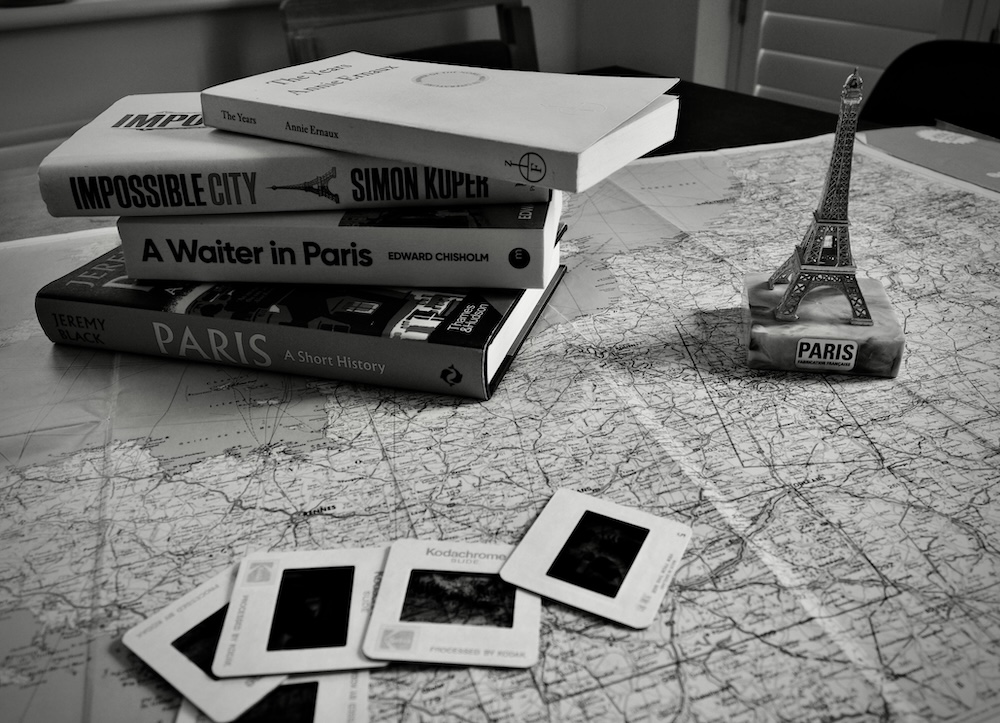
As my own memories of France fade (I’ve not visited, holidayed, gone there for work for nearly a decade) a new idea of France is starting to form in my mind that is only partially my own.
I didn’t plan to read Impossible City: Paris in the Twenty-First Century (Simon Kupar), A Waiter in Paris: Adventures in the Dark Heart of the City (Edward Chisholm) and The Years/Les Années (Annie Ernaux) in quick succession. One French thing just led to another.
This personal rethinking of France – most particularly of its sense of itself – was initially ignited by a fourth book, Paris – A Short History (Jeremy Black). It is, as its title suggests, a fairly conventional history of the city. But in its latter chapters it starts to deal with events – cultural, political, societal – that chronologically align with my first-hand experiences of both country and capital, starting in 1971 with our family’s first ‘foreign’ holiday, a camping trip to Royan in south-west France that would pass into family mythology and spawn ever more unreliable retellings. More holidays (often involving camping and bicycles), art school visits, a honeymoon, multiple work trips and press conferences would follow over the next fifty years. It was those business trips that exposed me to the less touristy cities and départements of France. Were it not for these, it’a quite likely I would never have experienced the singular pleasures of Clermont-Ferrand, Lyon, Limoges, Toulouse and the Grand Paris Sud area’s sprawling business parks.
As always with contemplating the past, disentangling actual memories from apocryphal retellings is a constant challenge. And I realise now that even my very earliest ideas about France were not entirely my own, but freighted with a certain anticipation of Frenchess. All manner of things fed into this ‘France of the imagination’ (to borrow Jeremy Black’s phrase) – the illustrations in our school French text books, the jokes TV comedians told, the characterisations of France and the French that seemed to be everywhere.
This France of popular and persistent stereotypes would later be augmented by cultural absorption: the films we watched at art school (Truffaut, Godard, Rohmer); the writers I read as a student (Zola, Camus, Flaubert, Sagan) and later Jean Rhy’s Paris novels; the painting and the painters I immersed myself in (Matisse, Dufy, Debuffet, Derain, Leger). I would become obsessed with the idea of a very specific artistic calling that would involve garret-based living in Montmartre or Montparnasse and easy access to cafés where artists and intellectuals would hunch around zinc-topped tables discussing art and existentialism.
Towards the close of Jeremy Black’s history of Paris he quotes the leader of France’s Green Party, David Belliard, who despairs at the persistent “stereotypical idea of Paris”. While Belliard’s specific concern is how this obstructs sustainable infrastructure developments in the city (his party’s cycle route plans for Paris being a predictable lightning rod for anti-Green rage), he warns more broadly that the city has created a trap for itself in becoming “an unchangeable Paris, a Disneyland … a fable that is neither desirable nor viable”.
****
Simon Kupar lands in Paris in the early 2000s seeking temporary refuge from extortionate housing costs in London and ends up staying for two decades. He arrives in Paris as coordinated efforts to prevent the city fossilising further into moribund museum state are gathering pace. The vast Grand Paris Express infrastructure project is the centrepiece of these, promising a more connected-up Paris. Crucially the project will link the outer suburbs – the widely disparaged banlieues – directly to the City of Paris, whose 20 arrondisements are effectively sealed off from the rest of the metropolis by a four-lane urban motorway. ‘Defended’ might be a better description given that the Boulevard Périphériquen almost exactly tracks the footprint of the city’s medieval fortifications.
Initially, Kupar’s entire experience of Paris is of its rarified centre, his social network made up mainly of fellow writers and knowledge workers who gravitate to the city’s bobo (bourgeois bohemian) neighbourhoods. But over time he meets a new partner, gets married, two children arrive and life settles into more quotidian routines. The challenge then is in cracking the inscrutable codes that govern everyday Parisian existence.
Kupar thinks he’s forming friendships with neighbours in his apartment block but quickly discovers these are merely behavioural conventions for more frictionless cohabitation. He struggles with Parisian dress code – observing something verging on obsession with notions of elegance – but learns this is something he must somehow intuit. Asking what you should wear at a particular social occasion would immediately mark you out as a plouc – up from the country/peasant (plouc, we learn, is very much the Parisians’ go-to insult for out-of-towners).
When Kupar’s children start school he is totally unprepared for the ruthlessly imposed joylessness of the French education system. Handing over his young children at the school gate to the receiving teacher is a smileless, transactional exchange (Kupar contrasts this with the head teacher at the English school who greets his young niece with a hug and a cheery run in Bea, my lovely (“words never spoken within the history of French schooling”). Parents, if they ever enter school premises, are treated as intruders. When interactions are unavoidable they are terse, such as this (from a parent-teacher meeting): “The teacher delivered her verdict: ‘there are no problems’. With that, she seemed to feel the conversation was over.”
Kupar suspects “receiving daily criticism from a tender age” has a direct bearing on French national character. He even vouches that “lasting negativity” of this experience explains the “Parisian mode” in general (“the bureaucrat, shop assistant or neighbour who addresses you like a teacher chastising a child”).
Along the way Kupar also learns some dos and dont’s about conversation etiquette (Parisian’s generally don’t welcome strangers entering into conversation with them – “remarking on the weather or football marks you out as a bore”) and public touching (“in Paris, you only hug someone on a special occasion, such as a funeral, or if they’ve been released from jail”). He discovers that the importance attached to élégance extends far beyond the sartorial, and speaks of something at the heart of the Parisian psyche. In this sense elegance is about maintaining “a certain opacity about yourself”. Opacity’s opposite quality, transparency, is meanwhile abhorred by Parisians (“frankness, bearing your soul all the time, isn’t valued at all”).
Elsewhere, Kupar is impressed at the insistence with which his Parisian neighbours claim to come from anywhere other than Paris, frequently invoking their terroir in deepest rural France. “I’m from Burgundy” declares a neighbour whom, as far as Kupar can discern, has spent her entire life in Paris. And he notices a distinct form of Parisian pride emanating from the conviction that the producer is king. Whether it’s taxi driver, newspaper vendor, shop owner “the producer will do everything to signal to you that you are in debt to them,” he says. You will see no clearer display of this kind of combative self-respect than from the Parisian waiter. Kupar observes that customers instinctively ignore the waiter and that waiters have developed a whole armoury of techniques to ensure they are acknowledged and, at least, begrudgingly respected.
****
Here, Edward Chisolm takes over to give a waiter’s eye view of Parisian restaurant clientele – but also of what lies beyond the swing doors of the restaurant dining room, that portal into a largely unseen world.

Chisholm, an English graduate whose luck and money have both run out as he struggles to make his way in the city of his dreams, is forced to take a job as a runner in a high-end restaurant (pseudonymously referred to as La Bistrot à la Seine, presumably as libel insurance). In the viciously hierarchical world of restaurant work the very first thing he is taught is to know his place – unequivocally, at the bottom. Fourteen hour shifts and minimum wages means that the restaurant runners must constantly ingratiate themselves to the waiters to secure even the tiniest share of the evening’s tips. Success or failure here is the difference between being able to afford to eat at the end of a shift or not.
A Waiter in Paris bears witness to the city at daybreak and in the small hours, which bookend those long shifts. It finds Chisholm at 5am hunched over a small espresso at the bar tabac around the corner from restaurant. A little after midnight, in the same street, he is the solitary customer at another bar where is making a vin rouge last as long as he decently can before trudging back to his freezing cold apartment (a tiny box room with “walls apparently made of cardboard”). Here, Chisolm’s account of the fractious relations he has with his Parisian neighbours chimes with Kupar’s – the impression formed, of a relentless war of attrition waged with weaponised pettiness.
La Bistrot à la Seine is grimly racist from top to bottom, with roles assigned according to a strict “caste system”. Tamil refugees are confined to the basement and the Pass (the filthy galley along which meals and finished with plates are conveyed). People from multiple other nationalities toil in the inferno-like conditions of the middle and upper kitchens, presided over by a French head chef. Non-white customers very rarely make it to the VIP tables, unless they are known to be extremely wealthy. Not infrequently, customers insist on not being served by a black waiter.
Chisolm steadily demolishes any idea that high-end Parisian restaurants might offer some kind of protection from the march of factory food, showing us that flashy establishments like La Bistrot à la Sein are as likely as anywhere else to serve microwaved mains and industrially produced baguettes. Given that gastronomy and French national identity and pride are so bound together this feels like a spectacular cultural own goal. But customers don’t seem to notice and the waiters and kitchen staff – who stick to the inexpensive family-owned establishments (typically serving a handful of regulars whatever the proprietor has cooked for themselves that day) found tucked away on back streets – are quickly beyond caring.
Despite La Bistrot’s fiercely enforced staff pecking order, a poignant fraternity forms among the lower ranks. Chisholm befriends members of the kitchen staff and probationary waiters, attends their weddings (and raves). And then, unexpectedly, bonds with the restaurant’s socially aloof sommelier. There is solidarity and pride bound up in savage energy of this increasingly beleaguered establishment (all the corner cutting is rapidly catching up with La Bistrot’s bottom line). And when La Bistrot à la Sein is permanently shuttered without warning, there is genuine sadness as the crew are disbanded. They linger for a while in the street outside the restaurant, then shake hands, wish each other luck and disperse into the unforgiving city.
****
Kupar and Chisolm’s portraits of Paris – and of France – are perhaps unavoidably anglocentric. Maybe they are portrayals of male-centered experience too.
So, a good place to end with is with Annie Ernaux’s The Years, the genre-shifting memoir that charts one Frenchwoman’s life from childhood into old age (from 1940-2006), but that is also the story of the collective experience of a country and its people.
****
The Years flickers into a life like a strange, hallucinogenic news reel. Its transfixing first ‘scene’ announces: “The woman who squatted to urinate in broad daylight, behind the shed that sold coffee at edge of the ruins in Yvetot, after the war, who stood, skirt lifted to pull up her underwear and returned to the cafe.” Well, it would be transfixing if Ernaux doesn’t cut straight to the next snatched memory – “the tearful face of Alida Valli as she danced with George Wilson in the film The Long Absence” – and another – “a flasher who reveals himself to a row of seated girls from the first class carriage of a departing train”. More vignettes, spanning the decades, spool by at a seemingly faster and faster pace and then, abruptly, they stop.
When they restart, the narrative slows and Ernaux leads us through the years and decades, mingling memories of domesticity – family gatherings, Sunday launches (where the subject of war and privation dominate conversation in the early years), household chores – childhood friendships and national events. “France was immense,” Ernaux recalls, “composed of populations distinguished by the foods they ate and their ways of speaking. In July, the riders of the Tour de France cycled across the country, and we followed them stage by stage on the Michelin map tacked to the wall”. Meanwhile, “the gateway to the exotic was the nearest town, the rest of the world unreal”. As for the nation’s capital: “Paris was beauty, a powerful and mysterious entity”.
From teenage years, a recollection of “the adults talking in hushed tones about ‘the Algerian crisis’” jostles with lists of popular French brand names and product innovations. There is national excitement about the arrival of convenience foods. “We were continually amazed by the amount of time we saved with instant powdered soup” (powdered soups – Royco, Knorr, Maggi – feature in my own memories of early camping holidays to France, and I wonder if they wield a particular power in the French imagination).
Awareness of social hierarchy and of knowing you place in provincial France are brought into early sharp focus. Those who failed their school exams – Le Brevet – “knew the weight of indignity at an early age”. A former schoolmate who had enrolled in a commercial school or started an apprenticeship would be ignored in the street by Ernaux’s peer group, while, in turn, “a notary clerk’s daughter with her fading ski-tan, proof of her superior social rank, would not so much as glance at us outside of school”. Passing Le Bac, the second big educational milestone, “would open the door to the summer of our lives and grant us social existence, the true reward, for which, surely, would be a love affair”.
A first paid job supervising a summer camp, far from parental eyes, provides a “heady new mingling of the sexes, where, wearing jeans, Gauloise in hand, we took the stairs two at a time down to the cellar and the music or the surboum”. Shortly after, memories of a first sexual encounter are evoked – then, the recounting of a romanticised reimagining of the event to “shroud the melancholy of a failed deflowering”.
University is perspective-shifting, intellectually liberating – but, also, intensely discomfiting for Ernaux. A familial bond is broken as she enters a world entirely unknown to her parents (both left school at the age of twelve to work on farms and in factories before eventually running a small café and grocery shop in Normandy). Her working class roots severed, but not yet admitted to the liberal middle-class circle her student peer group inhabit, she is socially adrift (describing herself more bluntly as a “class traitor”). Detachedly, she observes the contemporary symbols of student dissent, “the Che posters, the photo of the girl from Vietnam”.
Ernaux immerses herself in literature and resolves to become a writer, a plan forestalled by marriage, childbirth and domesticity – almost incomprehensibly so, for such an ardent advocate of second-wave feminism and body autonomy. The exhilaration of being on the threshold of adulthood flips into quiet resignation at the prosaic ways in which entry into this new realm actually happen: “We began to patronise places we’d never really been to before, the Casino supermarket and the Nouvelles Galleries” … “we settled down, got married” … “time took on a regular rhythm, carved out by a work schedule, bath time, the Magic Roundabout and Saturday shopping”. There is bitterness that “as we reach adulthood we are expected to perpetuate tradition as a matter of course”. And the withering conclusion: “I’m a petite bourgeois who has arrived”.
Ernaux’s clear-eyed view of the world, sometimes so emotionally detached as to be cold, cruel even, is a defining characteristic of The Years. But despite the bathos of her domestic predicament she offers an unexpectedly tender portrayal of early married life and how, through an accumulation of everyday activities, “we build our common trove of memories”.
The national rupture of May 1968 will become an indelible memory for an entire generation. But the promise of sweeping societal change is quickly replaced by dismay at how short the revolutionary moment turned out to be. The sense of collective failure over the 1968 uprising casts a long shadow over The Years. Over time, raw anger is replaced with performative dissent. Ernaux is merciless in her takedowns of ‘bobo’ affectations. Of those who holidayed in Yugoslavia, Albania or Hungary (and would take care to let everyone know), she writes, “they wanted the world always to have countries devoid of progress”.
The deaths of a string of French public intellectuals – Jean-Paul Sartre, Michel Foucault, Simone de Beauvoir and Roland Barthes all within the space of six years – seemed to stun France. Ernaux records that “over a million followed behind the coffin of Barthes”.
By the 1980s and 90s, rising immigration has pushed its way to the political foreground. Weaponised by France’s ascendant far-right, it also prompts a “virtuous class debate” among liberal academics (“they were convinced they possessed the best of all arguments against racism – that is, we need immigrants for the work the French no longer want to do”, Ernaux records dryly). The unifying effect of France’s 1998 World Cup victory under the slogan ‘Black, Blanc, Beu’ (Black, White, Arab) – a play on the blue, white, red of the French tricolour – is short-lived. The slogan itself quickly comes to be viewed as an establishment construct and distraction from systemic racial and socioeconomic divides. And all the time, deep prejudice remains ingrained. “That they (immigrants) called themselves French we privately found absurd”.
With the decades’ advance comes a fading emotional investment in political activism. Older causes are less strenuously defended, and there is embarrassment at the collective apathy towards the latest causes célèbres. “We didn’t care (about war in Yugoslavia)” … “we couldn’t get excited about Maastricht despite the injunction of a pressure group of celebrities”.
Ernaux is appalled by the voracious swallowing up of the French countryside by giant retail centres, where “monstrous quantities” of consumer goods provoke “battles between impulse and reason”, and where the obligatory branch of McDonald’s delivers a final insult to French cultural identity.
The coming of the Millennium seems momentous but ends up a reminder that our lives are not bounded by entities such as decades, centuries and millennia but experienced “only by a slipping by of the years that stood out, or didn’t.”
Ernaux finished writing The Years in 2006. Facebook was barely two years old, Twitter just launched. So the way the book’s form and structure anticipate the way we now catalogue our own lives through our photo rolls and social feeds, feels somehow prophetic. The gnawing anxiety that, one day, these personal digital archives and memory proxies might entirely evaporate, feels similar to the foreboding that envelops Ernaux as she approaches old age: “All the images will disappear. They will vanish at the same time”.
At one point, Ernaux considers what it is that binds her own family together (the thought comes to her as she serves up coquilles Sain-Jaques and rosbif to her grown up children at a family lunch). It isn’t blood or genes, she decides, “only a present comprised of thousands of days spent together, words and gestures, meals, car journeys, a great deal of shared experience that left no conscious trace”.
The Years closes as it begins, with memories summonsed from the deep past, freeze-framed on the page … “the village fête at Bazoches-sur-Hoëne with the bumber cars” … “a bar and a jukebox that played Apache” … “the dazzling sun on the walls of the San Michele Cemetery”. It stands apart from the other books in my accidental French quartet in that its biggest themes are universal ones. But, still, the particularities of place, culture, customs – all that granular Frenchness – are so dazzlingly evoked that I often found myself experiencing anemoia, that strange nostalgia and yearning we sometimes have for a time and place we’ve never known.
****
Yesterday, a scene from Erich Rohmer’s film A Summer’s Tale/Conte D’Été dropped into my Instagram feed. It featured the Breton seaside town of Dinard, the location of some of my own summer holidays. The washed out hues of the film old stock lent the scenes a chromatic parity with my memories of the place, hazy, low-contrast (and soundless).
****
A fascinating 2022 paper by Schlintl et al explores the “role of olfactory imagery as a retrieval method for autobiographical memories”. I came across it when I was thinking about what single thing or sensation would most redolently evoke the France of my memory. I decided it would be the smell of the combined inventory of a bar-tabac-presse in a small French town in the mid to late 1970s. This would be contributed to by the espresso on the bar counter, the packs of Gauloises and Gitanes behind the till, the national and regional French newspapers in the racks hanging from the door and the CaramBars and Hollywood chewing gum, always positioned next to each other at the end of the bar.
****
Today we begin our annual ritual of watching the Tour de France on TV. The sun-drenched French countryside, the little towns with their Marie, bar-tabac and bell tower, and the stage finishes on grand boulevards will roll by for a full three weeks and will will drink them all in.
We will agree, once again, with Alain de Botton that some of the finest benefits of travel can be achieved without physically going anywhere. And I will be reminded that France is, indeed, immense.


Leave a Reply