Why am I just about the only person of my age that I know who rides a bicycle as transport? It’s a question I’ve been asking myself quite a bit lately (in my head, obviously).
In struggling to answer it, I want to make an analogy between cycling and drawing. Both are activities that we are encouraged to do when when we are very young. Drawing is regarded as central to early years development (builds fine motor skills, helps with communicating emotions and thoughts, develops pre-writing skills). Learning to ride a bicycle is also firmly categorised as a ‘good thing to do’ when we are young (improves fitness, helps focus and learning, is a fun way to get around). But encouragement levels for both activities rapidly evaporate as we get a few years older. Drawing is suddenly something that is compartmentalised in our lives, and typically confined to school art lessons (where they still exist). Bicycles languish in sheds as older children become self-conscious about public displays of physical activity. Or decide that cycling is too ‘young’. Or – I’m going to put out there – abnormal.
I rode a bike as a small child. But I stopped for a few years, I think from the age of about eight or nine. There was probably every chance that I would never take up cycling again. But a fortuitous turn of events ensured my return to the saddle. In November 1971 (I would have been 15) a close neighbour had just returned from working in the Netherlands for a couple of years. He’d bought himself a bike to get around on there, where cycling was entirely normalised as a form of adult transport. Back in Britain he couldn’t see himself using it. So he sold his beautiful silver-green PX-10 Peugeot racing bike to my dad. And I was given it for Christmas.
I couldn’t quite believe that I owned something so sleek and sporty. But it wasn’t just the exhilaration of speeding down the country lanes at the back of our estate near Croydon that unleashed the happy hormones. I was also instantly in thrall to the aesthetics of cycling: the time-perfected geometry of the bike frame; the way sunlight glinted on a polished hub; the purr of firmly pumped tyres on fresh tarmac; the satisfying ker-click of a perfectly executed gear change.
Very quickly I realised something profound had happened. I had become a cyclist. I belonged. But in a way that I now realise is characteristic of me, it was a loose, unbound type of belonging. Because apart from a few cycling holidays with friends, my cycling has always been largely a solo activity. Nonetheless, in 1971, I did feel part of a welcoming, mild-mannered fraternity. Cycling was different then.
Part of the appeal of cycling was that it was a way for me to express my embryonic environmentalism. A bicycle embodied progressive values and ‘pedal power’ was a way to challenge the dominant car culture, which I was pretty sure I was against. There was something else going on too. I hesitate to call it spiritual, but maybe transcendent is an apt description of the experience I felt on my bike when ‘everything came together’. So far, so Zen.
In 1976 my Peugeot went with me to art school in Corsham, near Bath. I used it every day to get to my studio from halls. It tranported me to country pubs, the local supermarket and to the digs of out-of-the-way student friends. Even at this early stage of my cycling life I used my bike mainly for getting from A to B.
In 1979 I moved back to Croydon, and then to various allegedly ‘up and coming’ parts of South London. First my Peguot was stolen. Then my Pearson. Then my Claude Butler. Each of which was a replacement for the former. Cycling was becoming less Zen, and I do think I questioned the wisdom of offering up yet another bicycle sacrifice. But I went ahead anyway and bought a Raleigh Rapide from Geoffrey Butler (RIP) in Croydon. I rode it each day from Battersea (home) to Croydon (work) and back during the mid 80s. On most days this was far from spiritual, but I still loved the sense of independence it gave me. And the residual art student in me, still with a hankering to be marked out as ‘alternative’, enjoyed the fact that my work colleagues thought it odd for a grown adult to actually choose to cycle to work when trains, cars and buses were all available.
When we moved to Kent in the 1990s a bike commute wasn’t an option. We did do a bit of exploring locally on our bikes when we first moved, but gradually it became more of an occasional thing. For the first time, my cycling became something done for its own sake (as in ‘going for a ride’, as in a short, medium or long ride). And between rides my Raleigh Rapide spent more and more time in the shed.
And that’s the way it was, with cycling and me, for a good decade or so.
And then I bought a Brompton folding bike. It was revelatory, a cycling reset moment. For a small wheeled bike the Brompton ride is really very good. But it’s the practicality and convenience that changes everything. The Brompton’s compact form when folded (folding and unfolding a Brompton tales about 15 seconds with practice) means it can be stowed away in small spaces, taken on a train, or flung in the boot of a car. Mine sits in our hallway, tucked behind the front door. Crucially, it isn’t in a shed or garage – I literally have to walk past it to leave the house. As a consequence of all these things I use it pretty much every day. Quite often two or three times a day. I use it for shopping, nipping around town, visiting my mum, going out for coffee – I might add in a couple of decent hills to make it feel a bit more like exercise. I get around town at about three times walking speed, which at certain times of day is slightly better than average car speed. I can park the bike securely – for free – just about anywhere, something made easier by the Brompton flip-wheel parking mode (we’re very nearly at the end of the Brompton talk). So, why wouldn’t I choose riding my bike over walking or using the car?
Despite what I think of as the ordinariness of my daily cycling, I get the impression it is considered by neighbours and friends to be slightly eccentric, borderline odd. Adults who use their bikes as their primary transport – researchers call us ‘resolute cyclists’ – are still statistical (and possibly societal) outliers. Which makes me think back to my dad’s friend and the decision he made back in 1971 to sell his bike when he returned home from Holland. If he could be transported to 2023 in similar circumstances, would he do the same thing? I suspect he might. In the Netherlands today there are 23 million bicycles – 5 million more than there are Dutch citizens. Almost every adult cycles. It is considered normal, and not – as it often is here – something that is regressive, or a provocation (just say the words ‘cycle lane’ out loud in any public forum to test my hypothesis).
When a team of Italian psychologists investigated the behaviours of cyclists across Europe they segmented them into ‘practical cyclists’ and ‘green cyclists’. I feel I have a foot (pedal?) in both camps. Similarly, I seem to have both ‘hedonic’ (referring to the “positive emotions experienced while cycling such as excitement, pleasure, and control”) and ‘instrumental’ (referring to the utility or functionality of cycling) attitudes to cycling.
Fascinating though A cluster analysis of cyclists in Europe: common patterns, behaviours, and attitudes1 is (honestly), academic compartmentalism of cycling behaviours feels slightly reductionist to this cyclist. It’s not that the pleasures of cycling defy analysis, it’s just when I get on my bike I never think about being an active part of a mobility culture or about the “elasticities of cycling behaviour”2. I’m just along for the ride. And if that sounds at all perfunctory, never underestimate the unconstrained pleasure of bicycle aided self-propulsion.
- A cluster analysis of cyclists in Europe: common patterns, behaviours, and attitudes, Fabrioni et al, 2021
- It’s the mobility culture, stupid! Winter conditions strongly reduce bicycle usage in German cities, but not in Dutch ones, Ansgar Hudde, 2022
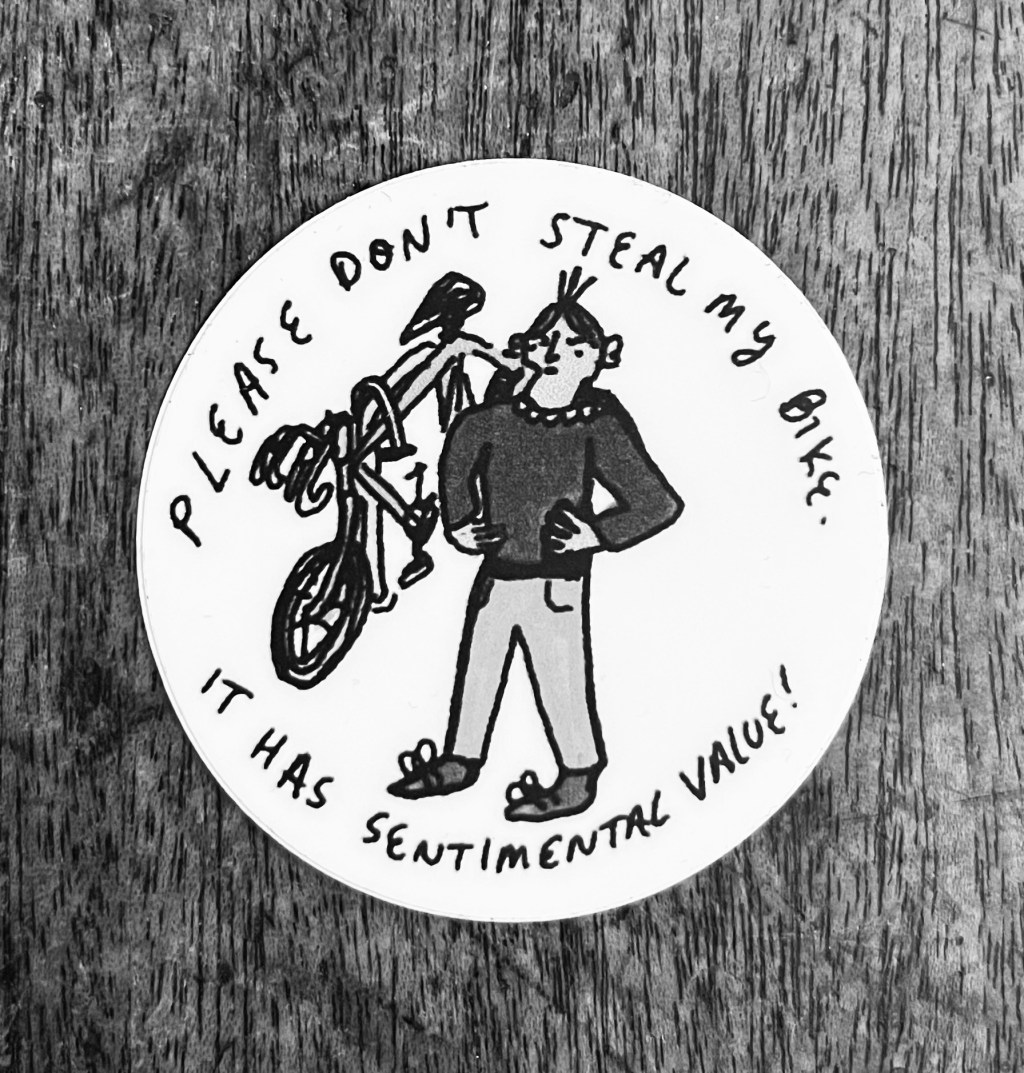
Main image: George Manson/www.georgemanson.com
 Jim Manson
Leave a comment