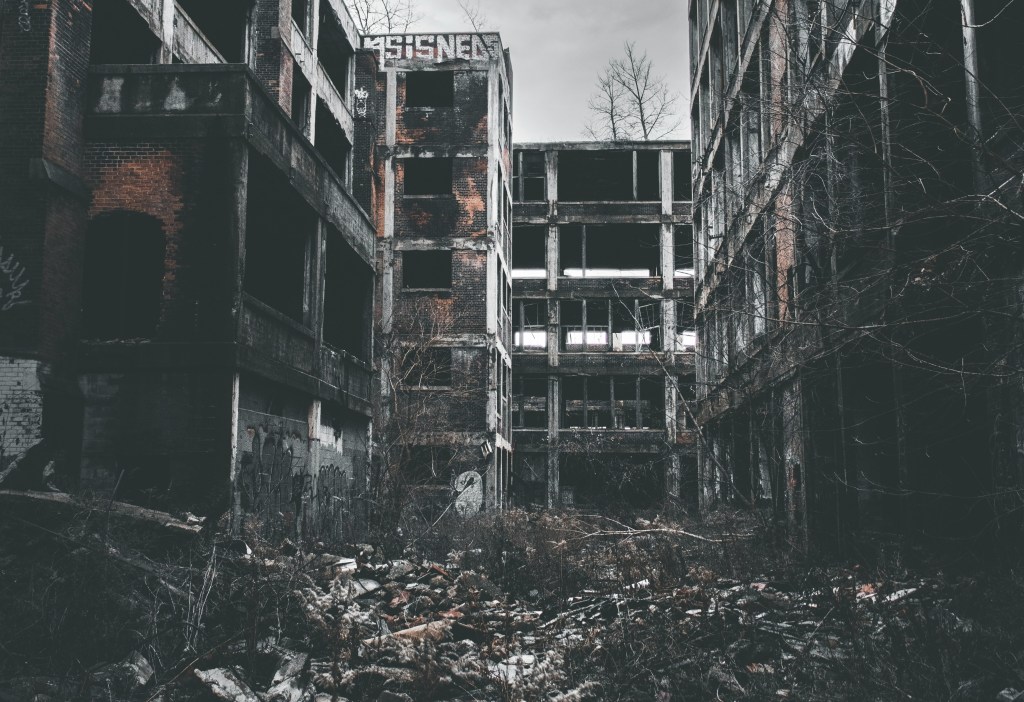
Themed art shows are popular with museums. For one thing it means that they can squeeze the pips of their permanent collections a tiny bit more. But if some of these shows feel as if they have sprung from the flimsiest curatorial conceit Ruin Lust (Tate Modern, 4 March-18 May) stands on thematically more solid ground.
The subject of this show – artists’ fascination with ruins and states of decay – is, of course, flush with symbolism. Ruins being variously memorials to past glories, premonitions of future catastrophe, the wreckage of ideas and ambition.
The show’s curator, the author and critic Brian Dillon, identifies this fascination as a relatively modern phenomenon. The German word ruinelust (from which the show’s very 2010s sounding title comes) first appears in the eighteenth century to describe the craze for ruins, that had suddenly gripped European culture. Dillon insists It simply couldn’t have happened any earlier: “One had to have sliced the past into discrete periods and imagined one’s own past was advancing half blind into the future, in order to think that history was speaking from the stones”.
The sudden arrival of ruinelust, initially a fascination with the classical remains of Greece and Rome, almost exactly parallels the invention of the picturesque as an aesthetic ideal (the word is first introduced into English cultural debate in the 1770s by William Gilpin in his Observations Relating Chiefly to Picturesque Beauty). Acting as a kind of aesthetic mediator between the opposed ideals of beauty and sublime, the picturesque fed perfectly into the romantic sensibility of the time. It also introduced the possibility of picturesque decay – Gilpin observing that ruins “acquire the ornaments of time”.
If picturesque decay is one mode of ruin action, sudden collapse or destruction is its spectacular counterpoint. The painting from the nineteenth century that most perfectly presages the latter is John Martin’s The Destruction of Pompei and Herculaneum. Setting the benchmark for artistic apocalypticism it is the very first thing you encounter as you as enter the current Ruin Lust show.
Things then quickly quieten down and for a room or two and it is picturesque decay all the way. The scene is set by Piranesi, the Italian artist known for his vedute of Rome and Venice, but who later turned to romantic and fantastical descriptions of classical and ancient ruins. More than content to juxtapose the Pyramids with the Colosseum, or invoke in impossible detail long-lost monuments and buildings, Piranesi revels in the decorative potential of decay. The “ornaments of time” are also present in other work by Turner – a spectrally luminous Tintern Abbey – and John Sell Cotman, whose Doorway of the Refectory, Rievaulx Abbey is watercolour perfection apart from anything else.
Ruinelust quickly got into the wider artistic consciousness. The idea had formed that the ruined state conferred high art historical status on once standing buildings and monuments. In this spirit the celebrated architect Sir John Soane commissioned the artist Joseph Gandy to paint his design for the Bank of England complex as an overgrown ruin seen from the air, in which the central London building stands on a craggy precipice washed in heavenly light.
The prospect of “the inevitable ruin” – part chilling, part thrilling – offered further psychological potential. Imagined future disaster, a subject heavily mined in nineteenth century literature, is explored visually in Gustave Doré’s 1872 reworking of Thomas Babington Macaulay’s The New Zealander. In Doré’s densely detailed engraving, a traveller from the future is depicted mournfully surveying a crumbling London skyline punctuated with classical columns, gothic spires and extravagant foliage, overlooked by a dome-less St Paul’s.
In the early Twentieth Century James Boswell’s The Fall of London: The Colosseum gave the expanding ruin repertoire a new twist – the image of rapid destruction brought about by violent insurrection. A series of eight lithographs portray an imagined Fascist uprising in Britain. Blackened and skeletal, standing amid scenes of urban carnage, Boswell’s ruins establish an altogether more menacing motif. Here they also announce a curatorial junction – goodbye The Pleasure of Ruins, hello Bunker Archaeology.
The full-on assault of Bunker Archaeology drops a bomb on Ruin Lust’s until now complex and layered account. Immediately, the show is reduced to a binary examination of the destructive consequences of war, and artists’ response to it. Unavoidably a subject in its own right, it means that Bunker Archaeology unintentionally is an island adrift from the main narrative. It is also the one part of the exhibition where the curators have leaned just a bit too heavily on the Tate’s own collection. So, whereas Paul Nash’s almost preternatural image of a field of wrecked aircraft by moonlight (Dead Sea 1940) explores new psychological territory, overfamiliar works by John Piper and Graham Sutherland exert a deadening literalism about their subject and add little.
But Bunker Archaeology does offer some genre connectivity. Jane and Louise Wilson’s Azeville, part of a series of photographs of World War II bunkers in Normandy, is simultaneously emblematic of the brutishness of war and the brutishness of monumentalism. And a reminder that in the 1930s the world sleepwalked into both. In that sense Azeville, with its own art photo monumentality, is the link work to the main theme of the second half of the show – the ruins of modernism.
While destroyed classical and biblical cities were the focus of early connoisseurs of ruination, the modern city was often present too. But when late Twentieth Century artists turned their ruin-loving gaze on the concrete utopias sprung from urban and social reconstruction after the war, a new and specific architectural lineage – buildings and towns whose very existence were brought about by destruction – presents a prospect dense with symbolism.
In 1967 the American artist Robert Smithson minted the phrase ‘ruins in reverse’ to describe the manner in which modern architecture seemed not to fall into to disuse but to ‘rise into ruin’. In the same decade the novelist JG Ballard seized on the idea too, suggesting that post-war high-rises contained a premonition of their own ruin. In Rachel Whiteread’s photographs of tower blocks in East London being dynamited the prophesy is fulfilled.
The paradoxical futurism of the modern ruin has informed video artist Gerard Byrne. His installation 1984 and Beyond is a filmed re-staging of a conversation between prominent science fiction writers of the 1960s, Ray Bradbury, Arthur C Clark and Isaac Azimov among them. In the original 1963 conversation commissioned by Playboy magazine the group of 12 writers imagine life and global politics in the future. In 2005 Byrne hired actors to re-enact the conversation, dressing them in Mad Men suits and capturing them in the colours and grain of old celluloid. As Bradbury and co project forward with hopeless inaccuracy about the future, the 2014 viewer is left pondering the melancholy of a squandered imagined world. This is the future seen through a backwards telescope, with the ruins of human ambition reflected back at us.
Ruin Lust is at Tate Britain from 4 march–18 May 2014
 Jim Manson
Leave a comment